Weaving Textiles, Weaving Resilient Community, and Weaving for Life
January 18, 2026
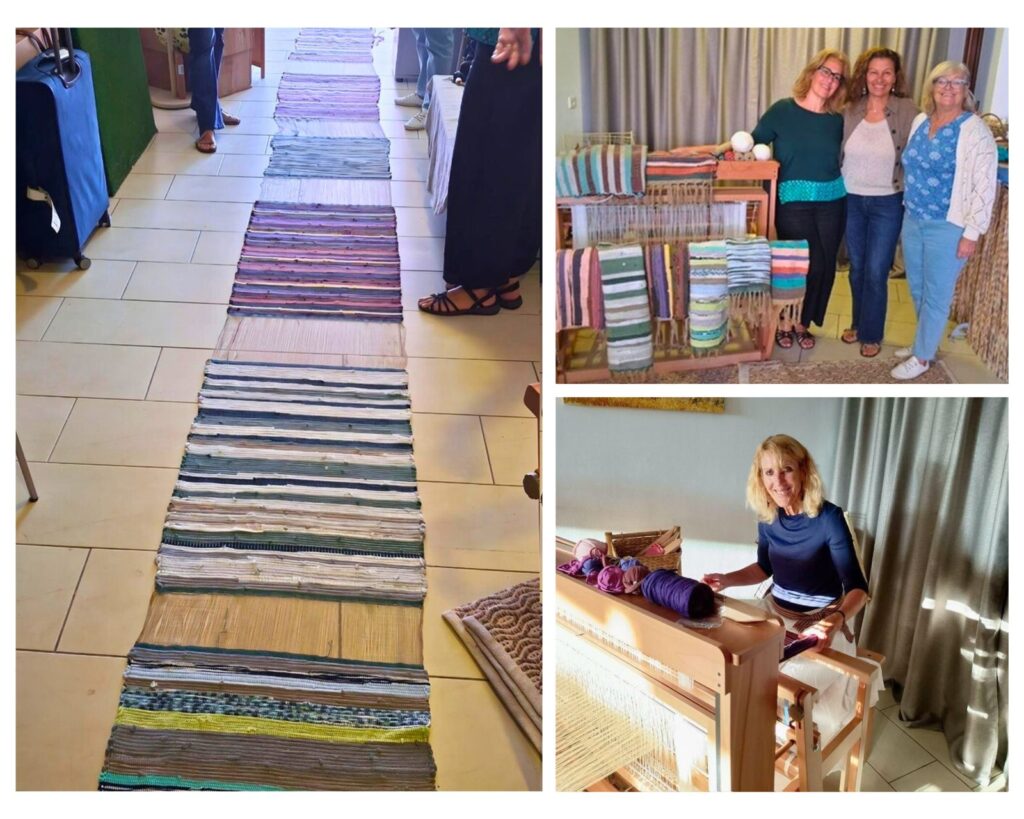
The mission of the Council for the Revival of Matriarchal Arts (CRMA) holds that weaving is an act of salvaging the forgotten and tattered threads of our traditional lineages to remind us of the preciousness of life, intergenerational wisdom, and to envision a viable and peaceful future. We appreciate that our hands are direct ambassadors of our hearts. This fact is echoed in Traditional Chinese Medicine channel theory which holds that the heart meridians emerge in the palms of the hands. Thus, by intertwining threads we experience ourselves as creators of material commodities and agents of positive change; weavers of both material and spiritual reality.
Our textile creations are therefore meaningful representations of our desires to heal and express love in the world. We cherish the opportunity to wrap our kin, and those feeling adrift in our fractured world, in our collective embrace as well as in the warmth of our woven textiles.
The expression “Matriarchal Arts” was coined in the conception of CRMA with deliberate intention and in a spirit of activism. It’s not meant to designate arts that necessarily were, are, or should be exclusively practiced by women or mothers, or presumed to be done better by women and mothers. “Matriarchal” is applied to invoke the ethos and behaviors associated with matriarchal social systems as they are delineated by the field of Modern Matriarchal Studies. The research-based definition of matriarchy according to this steadily advancing field of study asserts that the principle of nurturance is a cornerstone for creating and maintaining sustainable and peaceful social systems. “Matriarchal Arts”, therefore, imply activities that support social, political, economic, cultural, and spiritual activities and structures designed to holistically nurture and care for people and planet.
For some it may seem a leap, wildly romantic, or laughably naive to suggest that activities long considered mere handcrafts and hobbies in capitalist paradigms could be of determinant significance in highly organized social systems.
Nonetheless, the enduring and divine significance of weaving is well-documented in cultural memory all over the world. Artifacts and ethnographic evidence from ancient and traditional cultures suggest that weaving is—both metaphorically and practically—a sacred activity, symbolic of the cycles of life, death, and regeneration. Still to this day, the magic of weaving remains at the core of many cultural traditions. “Among the matriarchal Berber women of North Africa, the magic of weaving in the sense of life creation has been preserved. The woven piece is considered to be animated, and the weaver must guard it carefully. By crossing the threads, she creates a body and gives it its own fire of life. The cutting of the finished woven piece from the loom is equated with a birth, where the umbilical cord is cut.” (Goettner-Abendroth, translated from German)
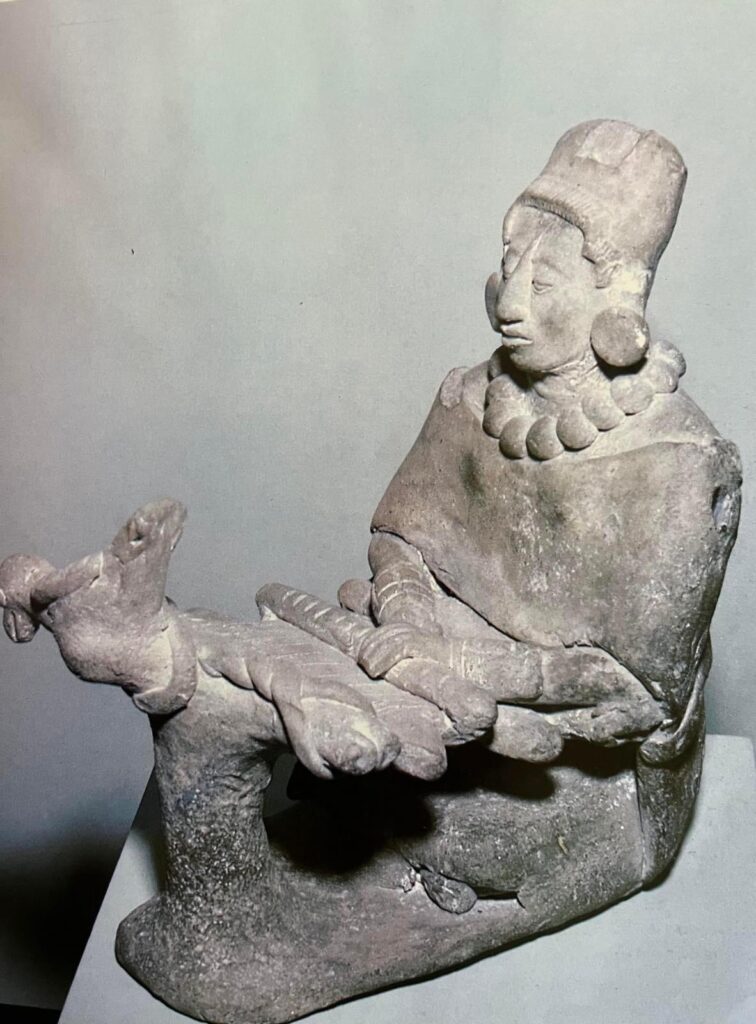
“Ixchel sits easily and with great presence, for she is the bliss of creativity, weaving the fabric of life itself. Each of us is a thread in her great pattern. Singing, spinning from her deepest being, she carefully smoothes the substance of every soul between her great fingers. She then chooses her color… Whatever color each of us is—whatever body, personality or character—we are purposefully created by the Goddess to make the Great Fabric of Life as it is meant to be. Having chosen carefully, she takes a deep breath of eternity, exhales the life force into each being and begins to weave. And so your life, and all lives, begin.”
Ixchel The Weaver, North America, 8th Century C.E. Image and Quote: Hallie Iglehart Austen, The Heart of the Goddess; Art, Myth and Meditations of the World’s Sacred Feminine
Some of the ancient deities associated with the arts of spinning and weaving include Spider the Creatrix from North America, the Mayan Goddess Ixchel, the Egyptian Goddess Neith, and the ancient Germanic Frau Holle. In ancient mythologies, the Goddess of the underworld often takes three forms: a spinner, measurer, and cutter. They are known in Germanic culture as Urd, Werandi and Skuld; in Ancient Greece as the ‘Three Moires,’ Klotho, Lachesis, and Atropos; and in Rome they were the Three Parcae. In Greece and Rome they are also referred to as “Fates” because they embody and invoke an understanding of the flow of life and death. (Goettner-Abendroth, 2023)
Moreover, in her book, Women’s Work: The First 20,000 Years, Elizabeth Wayland Barber demonstrates through archeological and historical record that women and textiles were important forces of economy and culture in early societies. Until recently, the history and significance of the early textile industry has been underrepresented in historical literature due to the perishability of the product (fabric) and the fact that the artisans were primarily women. Wayland Barber brings ancient women’s work and experiences into focus, revealing a legacy of highly skilled artisans that wielded economic influence and culture-defining relevance. We also find evidence in Wayland Barber’s account that women traditionally gathered together to weave, mind the children, to mentor one another, to sing and dance, and to enjoy one another’s company.
In the above examples we see that spinning and weaving mythologies that relay metaphors for life, and textiles as a medium of economy, are as timeless as the craft itself, suggesting legacies of deeply revered wisdom and cultural relevance.
My sense, however, is that the depth and sacred value of weaving wisdom lies beyond intellectual comprehension and saleable value. Rather, much of the “magic” of weaving is inherent in the nuanced layers of direct kinesthetic experience.
I dare suggest the oft-invoked mythologies and metaphor of weaving are applied by many who have never woven a thread in their lives. Indeed, I myself invoked the notion of weaving and tapestry whimsically and ethereally long before I knew anything of the actual skill, complexity, dynamism, and precision involved in creating a piece of cloth with my own hands. Regrettably, attribution of proper credit and respect has been long lost for ancestors and modern craftswomen and men who persist in preserving honed human aptitude for arts that nourish and protect humanity as well as the natural world. Indeed, among the innumerable casualties of convenience culture, intellectual elitism, and economic distortion lies the hard-earned sacred wisdom inherent in lineages of artisanship.
Full disclosure: I am speaking as a novice weaver, not an expert or a skilled artisan. Through the embodied process of learning, nonetheless, I am observing in myself an evolution toward increased patience in the face of frustrating mishaps, more confident and creative problem-solving capacity, and an expanding aptitude for sustained focus and steady persistence. Both in the process of learning and in my genuine appreciation for the wares I create, I am cultivating a sense of faith in my creative vision, as well as a renewed sense of blossoming authenticity and capability as a self-determined creator of material reality.
Perhaps the most magnificent magic to be regarded in weaving, I contend, and the essence of CRMA’s mission, is in the intimacy of learning together; in sharing creative space, stories, giggles—sometimes even tears—as we weave in community.
As our hands tend to the “busy work” of rolling yarn balls, threading bobbins, and tending the space, we listen to one another attentively and share candidly. We weave over, under, over, under on handlooms, and take turns at the floor loom, tossing the shuttle, beating the threads; toss and beat, toss and beat. Check the selvage; be aware of the tension; release the break, turn the crank. There is a discernible rhythm that emerges in the activation of the peddles, heddles, shuttles, and threads.
A rhythm of generative syncopation begins to permeate the surrounding air and ether; even the human systems in the room begin to hone in on a common cadence. An increasing sense of calm sets in; a feeling of belonging in this space, together.
Communal coherence is slowly and gently beginning to take root: our minds become more steady and focused, and the felt sense of an integrated whole begins to morph into being.
A simple dictionary definition of “coherence” is ‘a quality of forming a unified whole.’
Visit the HeartMath Institute for a scientific definition of Heart Coherence.
Thus, the entire tedious process of weaving fabric renders a working space, a blueprint, and a syllabus for weaving moments, relations, and dreams.
Now, if “weaving dreams” feels a bit “airy fairy” to those of us more comfortable in the realm of material manifestation, here’s a bulleted list of “why’s” to get our feet back on the ground.
Why weaving?
Why are weaving and other Matriarchal Arts necessary and effective strategies for meeting the ills of our time with decisive action?
What does weaving cloth have to do with spirituality?
- What we do with our hands matters. In her book The Heart of the Goddess, Hallie Iglehart Austen contends that “the hands are a universal symbol of manifestation, blessing and healing.” Human intelligence is squandered and exploited when we tap, tap, tap on devices designed to coerce attention and generate a hypnotic state. Touching things, and touching one another such as when we dance in a circle with joined hands, activates our heart channels, which emerge in the palms of the hands according to Traditional Chinese Medicine. This strongly suggests an integration of human intellectual and spiritual faculties in activities engaged in with the hands.
- Handcrafting develops embodied skill, experiential knowledge, and refined sensitivity in the craftsperson.
- Skilled crafts such as weaving integrate left (intellectual, logical) and right (creative, intuitive) brain capacities, promoting higher cognitive function and greater capacity for sound decision-making.
- Cognitive attention, felt sensibilities, and physical dexterity mature in the process of skilled crafting, promoting focus, earned insight (as opposed to insight gained from an expert or authority who said so), confidence, and agency to act in the world.
- Work exploitation and slave labor produce an inestimable volume of daily wares imported and exported around the world. Given the opacity of market conditions upon which we are currently dependent, mounting a meaningful challenge to the prevailing system requires taking steps toward increased self-reliance.
- Increasing self-sufficiency is a step toward decentralizing crucial life skills and wiggling free of dependence on corrupt superstructures that extract from the Earth and human workers inhumanely designated “human capital”.
- Direct appreciation for production process encourages more reasonable patterns of accumulation and consumption.
- Direct relationship to raw materials (including seasons of harvest and sowing, plenty and scarcity) and production process increases sensitivity to environmental realities of sourcing, extraction, and labor requirements.
- Integration of disparate pieces into beautiful and resilient fabric stands as an astute metaphor and translatable skillset for constructing resilient communities.
- Locally made handcrafted wares are medium for local and regional gifting economies. Gift-giving is an economic principle central to egalitarian, matriarchal paradigms. Local exchange of hand-crafted goods promotes relations based on warmth, human dignity, and appreciation.
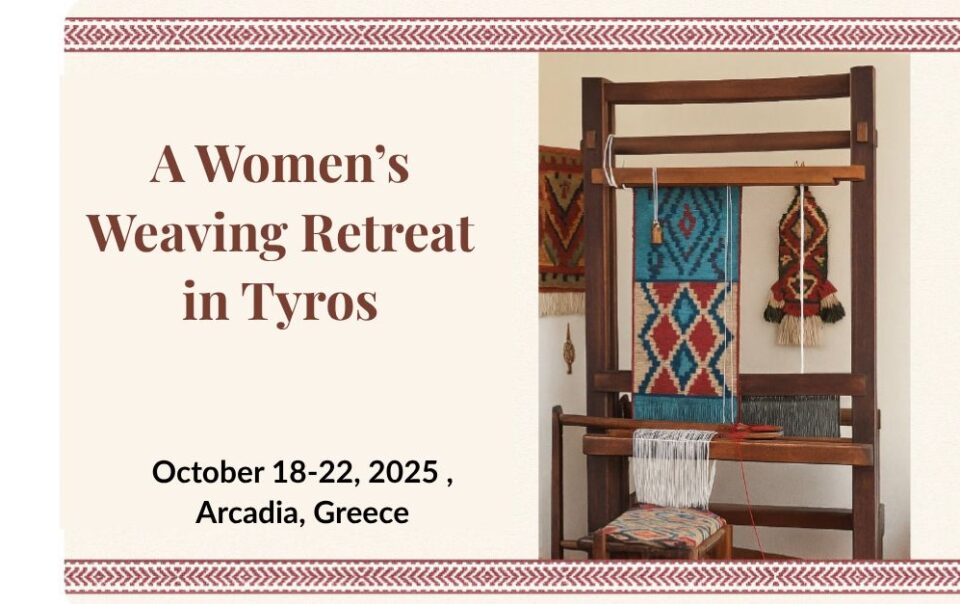
- Weaving legacies have often been transmitted through generations of grandmothers, mothers, and daughters, as in the modern lineage of women weavers of Tsakonika Ifanta in the Peloponnese region of Greece (read about our recent retreat in the Peloponnese). Skilled arts shared among women define lineages, create a context for meaningful intergenerational bonds, and preserve cultural heritage. Reverence for shared values, namely steadfast commitment to nurturing the preciousness of life, is elegantly integrated into otherwise mundane activities and wares.
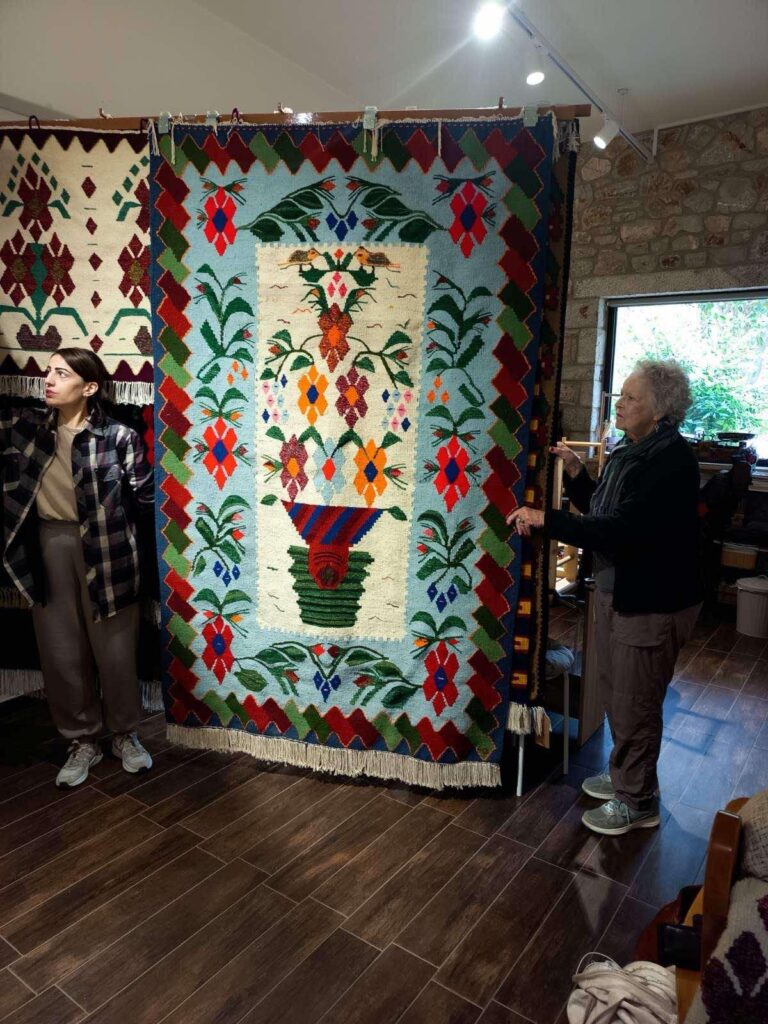
- Images, patterns, choice of raw materials, and textures in woven cloth, traditional costumes, and home textiles often reflect spiritual values, reverence for nature, and other culture-defining themes; hand-forged and ever-present reminders of self-determined communal codes of ethics, aspiration, and integrity. (Contrast this with the fact that many of our wares are branded with corporate logos).
- Weaving in community offers an opportunity to cooperate in meaningful endeavors; to experience not knowing and learning with humility; to be mentored and to mentor others. Respectful comradery is forged through encountering challenges together, deliberating on shared concerns, and accomplishing shared goals. Women express feeling relaxed, calm, accomplished, and happy after a session of creating together, reinforcing the desire and spiritual momentum to cooperate, grow together, and cultivate harmonious community.
The modern world that we know has evolved through the development of many important and meaningful technologies purported to make our life easier. Yet many of these useful technologies are applied irresponsibly, exploiting and demeaning the Earth and human energy. For CRMA, “matriarchal arts” are not merely fun crafts that girlfriends do together. Our intentions are deeply restorative, intentional, and spiritual.
We feel deep concern for the severity of angst that we are witnessing in the world. We are acutely aware that we navigate our lives embroiled in and dependent upon patterns of mass production, mass consumption, unchecked extraction, and careless, destructive waste. We point-and-click on a screen when we need a thing or feel hungry; scan our banking codes to make payment, and receive goods neatly wrapped in plastic, to be consumed in isolation and discarded when we tire of them. In addition to widespread cruelty, toxicity, and destruction, the human cost of global convenience and dispassionate commerce includes devastating atrophy of life skills, physical agility, relational sensitivity, and common sense.
The Council for the Revival of Matriarchal Arts holds that learning to weave together is an act of remembering and honoring our lineages. In doing so we revive the legacies of women who nurtured life and defined culture for entire societies. We experience the art of weaving as a medium for engaging with surviving threads of cultures that sustained themselves independent of governing superstructures and impositions of extractive global economy. Learning to cross threads, therefore, is a bold step toward revival of cultural and spiritual wisdom and practical skill necessary for a viable social and ecological revolution.
References and Additional Inspirations
Goettner-Abendroth, H. (2013) Matriarchal Societies: Studies on Indigenous Cultures Across the Globe. New York: Peter Lang.
Goettner-Abenroth, H. (2023) Matriarchal Societies of the Past and the Rise of Patriarchy; West Asia and Europe. New York: Peter Lang.
Goettner-Abendroth, H. (2023) Symbolism of Earth and Cosmos; Matriarchal Mystery Festivals, Tarot Cards, and Astrology. Christel Gottert Verlag (Translated from German)
Iglehart Austen, H. (1990). The Heart of the Goddess: Art, Myth and Meditations of the World’s Sacred Feminine. Berkeley: Wingbow Press. www.heartgoddess.net
Makilam. (2007). Symbols and Magic in the Arts of Kabyle Women. New York: Peter Lang.
Makilam. (2007). The Magical Life of Berber Women in Kabylia. New York: Peter Lang.
Wayland Barber, E. (1996) Women’s Work: The First 20,000 Years – Women, Cloth, and Society in Early Times. New York: W. W. Norton & Company.
The True Cost Documentary: https://truecostmovie.com/
2024 List of Goods Produced by Child Labor or Forced Labor (U.S. Department of Labor, Bureau of International Labor Affairs): https://www.dol.gov/sites/dolgov/files/ILAB/child_labor_reports/tda2023/2024-tvpra-list-of-goods.pdf. Textiles: https://www.dol.gov/agencies/ilab/reports/child-labor/list-of-goods-print?items_per_page=10&combine=textiles
Walk Free Global Slavery Index: https://www.walkfree.org/global-slavery-index/map/
Knitting Versus Capitalism: Why Making Things is Radical: https://www.youtube.com/watch?v=IAnPIubERs8
The First Time I’ve Woven in 26 Years; Peruvian women Revive Arts Lost to Trauma of Forced Sterilizations:
https://www.theguardian.com/global-development/2024/sep/23/its-the-first-time-ive-woven-in-27-years-peruvian-women-revive-arts-lost-to-trauma-of-forced-sterilisations
Maternal Gift Economy Movement: https://www.maternalgifteconomymovement.org/
About the Author:

Jennifer Eva Sirel-Pillau, mother of two, is a founding member of the Council for the Revival of Matriarchal Arts (CRMA). Jennifer holds a bachelor’s degree in business administration, a master’s degree in Traditional Chinese Medicine, as well as certifications in Ayurvedic Practice and Craniosacral Therapy. Her interest turned to matriarchy when it became clear in her role as a healer that virtually all chronic illnesses—physical, emotional, spiritual, and relational—share root causes that can be traced to the degradation of our social and ecological fabric. She studied matriarchal societies and matriarchal theory at International Academy HAGIA, based in Germany, with the institute’s founder, Dr. Heide Goettner-Abendroth. During this experience, she wrote a two-part thesis entitled “In the Beginning: The Real Meaning of Matriarchy,” and “Men in Matriarchy: Toward a World of Relational Integrity.” Her pen name is the name of her mother’s Estonian lineage.