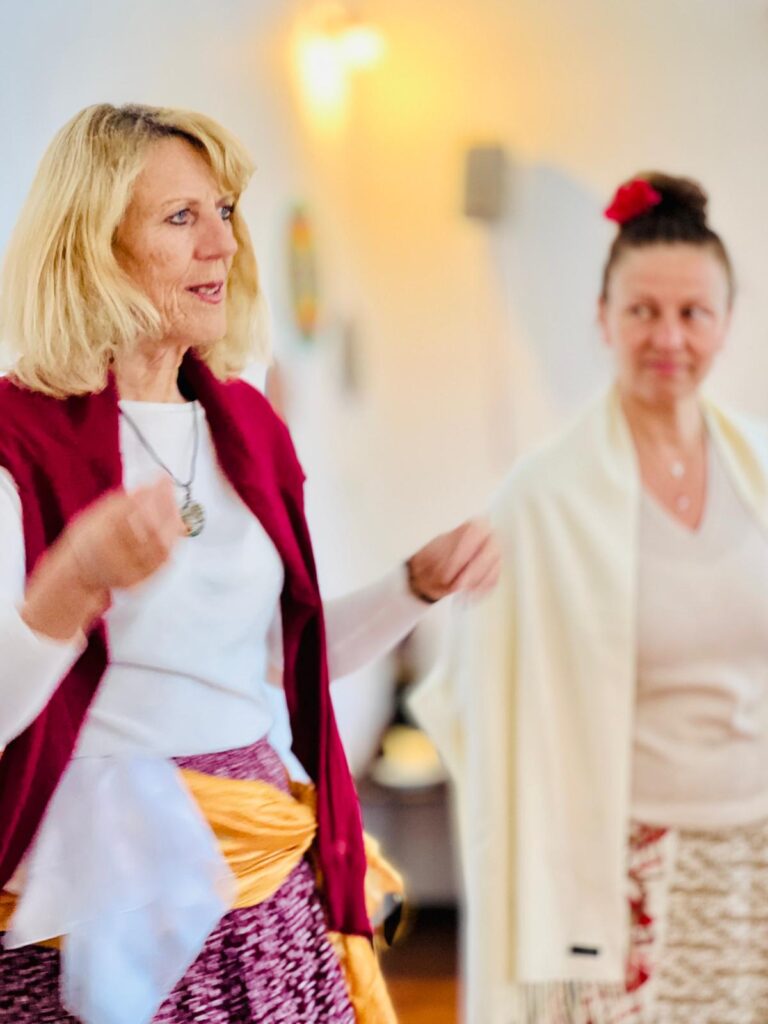
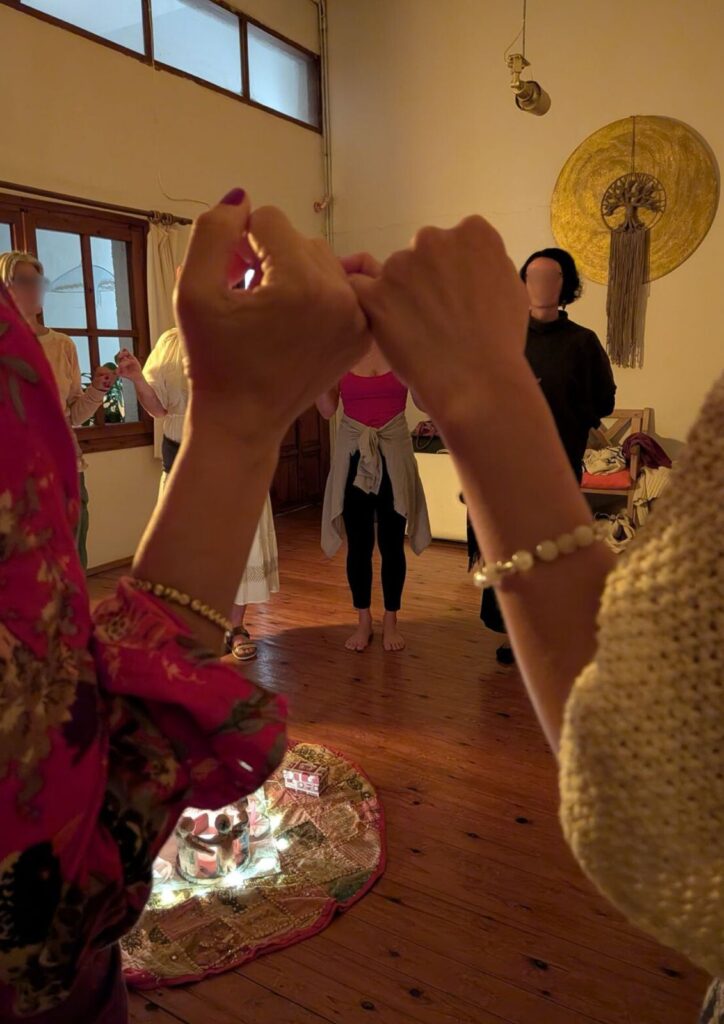
I have been engaged in studying the dancing cultures of Asia Minor, the Balkans and Greece for many years. I feel very fortunate to be living on an island with great geomantic energy.
According to Pogacnik: “geomancy is composed of two Greek words – one standing for the
Earth (Gea or Gaia) – and the other one for divination (Gr. ‘mantein’) – Geomancy” (Pogacnik, M., Sacred Geography, 2007). This definition implies the divine dimension of the earth. Particularly here in Crete, where the dance culture is rich and very much alive, I feel the vitality inherent in the traditional dances.
As a trained Qigong practitioner, I am familiar with the energy flow and circulation within the body.
This understanding allows me to impart this knowledge in activating self-healing processes.
Dance and music belong together. Thus, it is not only the dance itself that affects us; the music also plays a key role. Western music no longer encompasses the frequencies that are conducive to healing the body. The musical traditions of Asia Minor, as well as ancient music in general, include half-tones, which create ideal conditions for healing. Modern science has confirmed that specific frequencies are healing.
It has also shown that the music of ancient times (circa 4000 BC), was composed of such frequencies.
In those times, people did not need pills. They were knowledgeable about the various properties of the surrounding herbs and plants, and they applied these natural, organic agents in their healing processes.
And of course, they danced. Dancing was inherent in every occasion; for celebrating major passages of their personal lives, as well as the cyclical passage of the seasons in nature. Sometimes they danced even while preparing food.
Movement is natural and arises organically from within the body, as does dancing. Practiced in combination with singing and the special ancient frequencies, ritual dancing creates a delightful experience, creating harmony among body, mind and soul.
Dancing with unconditional devotion, integrity and in unison with one’s soul is synonymous with the act of loving. The same applies when we paint an image in this way, or cook a meal, or knit a sweater.
The act of loving is healing.
That is what I understood in the process of remembering my lineage; by being engaged in reviving the female traditions and women’s matriarchal arts. This includes the wisdom contained in women’s ritual dancing, where each position of the hand, each step and each swinging motion has meaning and significance. In this way, the dance movements express grace and beauty, and reveal the vital and culture defining roles women played in matriarchal culture and societies.
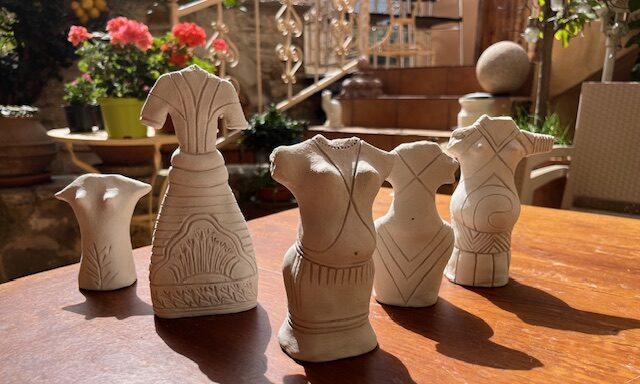
Further affirming the significance of dance in culture, patterns identified in women’s needlework often reflected dance patterns (e.g. the meander), real-life situations (e.g. birth, death), nature (e.g. plants, trees) and women engaged in dance. In pottery art we can also find many such examples.
Matriarchal societies are organized in circle-like structures (rather than hierarchical), including also spiraling and cyclical patterns. They are dynamic just like the circle dances. Behaviors such as practicing communal dancing and lending mutual support to each other increase the potential of healing frequencies.
The community that exists in a dance circle allows its members to experience harmony for the duration of the dance time. This then becomes a somatic memory which holds the potential to motivate participants to seek ways of living their lives beyond the dance circle in balance and peace.
In this way, dance and music can contribute in significant ways towards the healing of our society.
References:
Pogacnik, Marko: Sacred Geography – Geomancy: Co-Creating the Earth Cosmos, 2007
Wilhelm, Richard: Das Geheimnis der Goldenen Blüte-Ein Chinesisches Lebensbuch,1973
The Secret of the Golden Flower – A Chinese Book of Life, 1962
Levy, Fran: Dance/Movement Therapy – A Healing Art, 1992 Gimbel,Theo: Form, Sound,
Colour and Healing,1987
About the Author:
Claudia Welter is a certified Qigong teacher and circle dance teacher, and has been leading various groups for 25 years. She has been an active member of a choir for 33 years. Her dance teachers include: Jannis Korosidis from Pella, North Greece (1995-2007): Dances from Asia Minor and Greek Island dances
Petros Selkos from Naousa, North Greece (1999-2005): Dances from Macedonia and Bulgaria
Edda Autolny from Germany (1995-2007): Dances from all areas in Greece
Laura Shannon from USA (2023 2025): Women’s Ritual Dances; ancient dances from Greece, Albania, Armenia, Bulgaria, Romania, and Israel.