A Conversation with Kirsten Mus About Clay, Creativity and Care
What ancient forms and the act of making can still teach us
Some places stay with us because of the way they make us feel. And when we begin to know the stories they hold, they stay with us even more.
I had visited Kirsten Mus and her husband Jørgen at their home in Fres before I brought my daughters there for a CRMA clay workshop. I already knew that Huset i Fres was not an ordinary house. It is a place created over many years, filled with objects and architectural elements that had lives before arriving there. I had heard some of their stories before, and one in particular had stayed with me so strongly that I knew I wanted my children to experience this place and meet the people who had created it.
So when we organised a clay workshop at Huset i Fres, six children gathered there one summer morning. Kirsten introduced them to the material they would be working with and showed them some of its possibilities. Rather than giving them something specific to reproduce, she allowed them to follow their own ideas and offered help when they needed it.
I participated too. Knowing about Kirsten’s interest in the archaeology of Crete and in the work of Marija Gimbutas, I asked her for some inspiration. She brought me a book filled with images of Neolithic female figurines, and I began making my own form inspired by them. My daughters became curious about what I was doing.
A conversation about these ancient objects emerged naturally while our hands were busy with clay.
A few weeks later, I returned to sit with Kirsten and Jørgen and talk more deeply about some of the ideas that had surrounded us that morning. Our conversation began with clay.
From the Earth
Kirsten Mus was born in Denmark and has lived in Crete since 1986. She is an artist working with ceramics, glass and tapestry, and both the archaeological artefacts of Crete and her life on the island are important sources of inspiration for her work. She is particularly interested in the archaeological theories of Marija Gimbutas. For many years she has also worked as a teacher and cultural mediator, and she is a co-founder of the Council for the Revival of Matriarchal Arts, CRMA.
In her CRMA biography, Kirsten describes what the organisation means to her: “CRMA gives hope that our world can be changed into a society where love, care and community are the supporting foundation.”
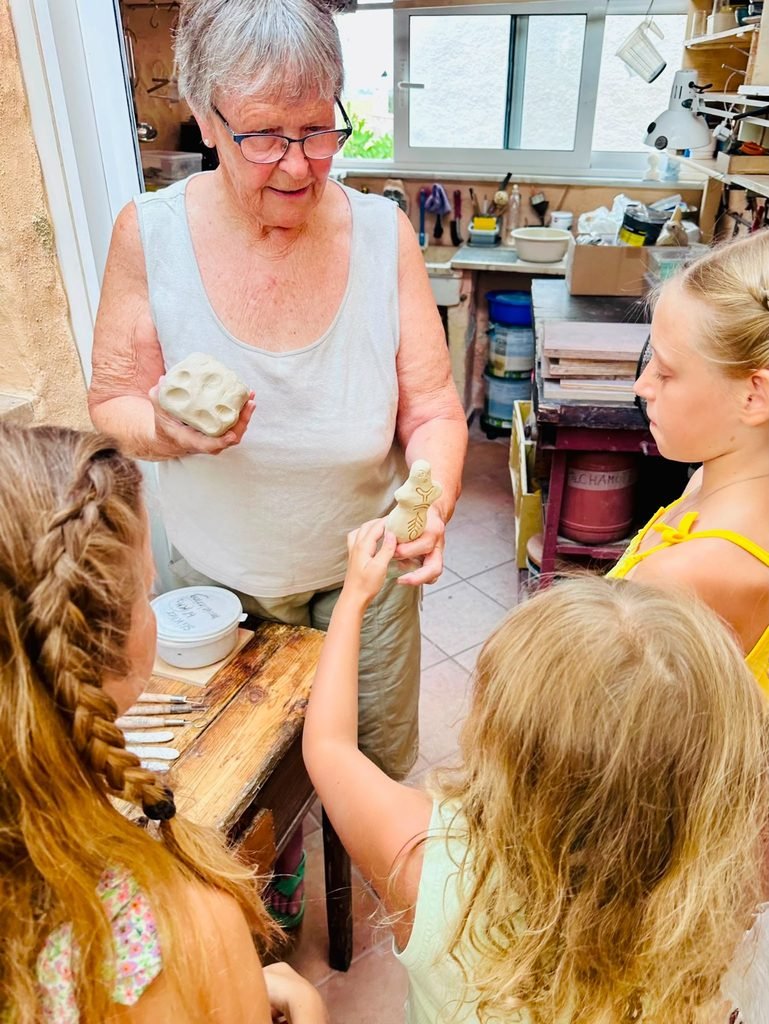
During the children’s workshop, I remembered Kirsten telling them that clay comes from Mother Earth. When we met again, this became my first question. What did working with clay mean to her personally?
Kirsten began with the material itself. “For me, I think from the first time I met clay, I was so amazed by this stuff.”
She spoke about its softness, the pleasure of touching it and the possibility of forming almost anything with our hands or simple tools. But she also wanted children to understand where the material comes from. Clay is found in layers in the earth, she explained, and humans discovered its possibilities many thousands of years ago. At some point they also discovered that when clay came close to fire, it changed
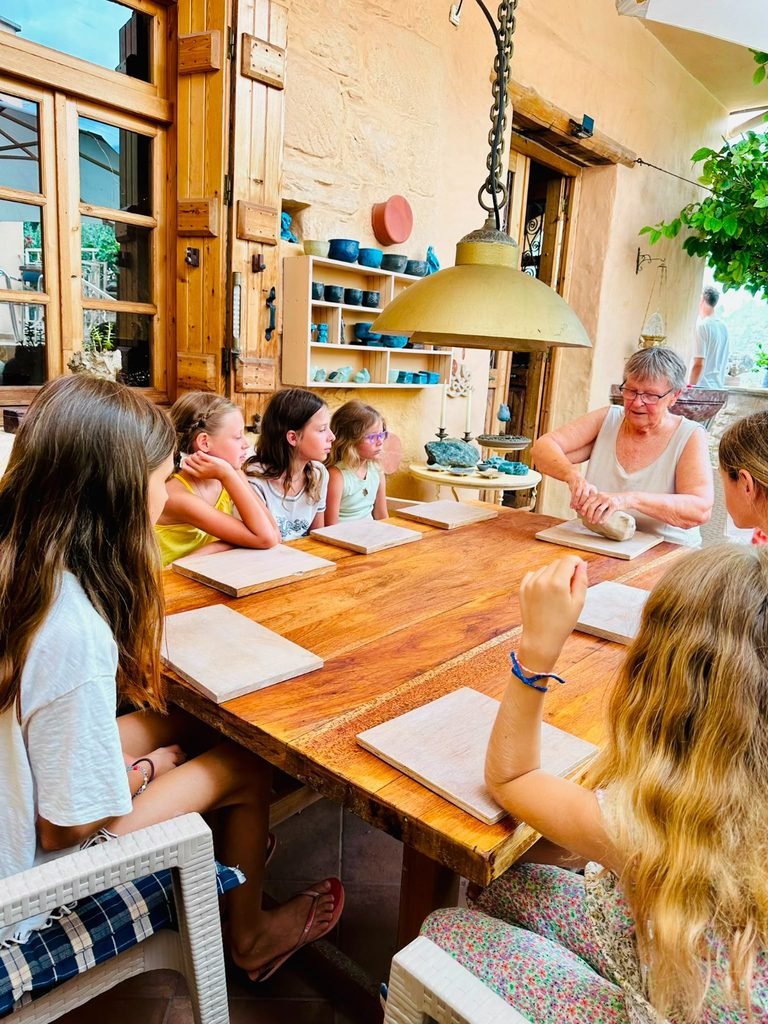
Before firing, dry clay can be returned to water, worked again and given another form. After firing, that possibility disappears. A chemical transformation has taken place. For Kirsten, that permanence is significant.
“We shall be a little careful what we like to keep for the people that comes after us because the claywork, when it’s fired, it will stay.”
This means whatever we make now may one day tell a story about us. She connected this directly with archaeology: people today find what earlier generations left behind and try to understand something about their lives. Fired clay is one of the materials that can survive for an extraordinarily long time. Our conversation had begun and had already opened a much larger question: what are we leaving for the people who come after us?
When Clay Was Part of Everyday Life
Kirsten’s relationship with clay is closely connected with Crete. She told me about becoming fascinated in the 1980s with the enormous traditional Cretan clay storage vessels, the pitharia, and wondering whether anyone on the island was still making them.
Her search led her to a family of potters who were still producing large vessels. Later, together with a group of Danish potters, she participated in experiments with making large pots, and in 2006 she and Jørgen worked on another project creating them for an exhibition at the Danish Institute in Athens.
Kirsten emphasised their practical importance. Large clay vessels were essential for storing crops, oil and other food. She also spoke about stamni, clay containers used for water. Because moisture could evaporate through the unglazed clay, the water inside remained cool. These objects belonged to everyday practical life. People needed them.
Today we often encounter such vessels carefully preserved and displayed. For the people who originally lived with them, they were objects to be filled, emptied and used.
The vessel may remain long after most of the ordinary life around it has disappeared
Marija Gimbutas and Looking into the Past
From the practical uses of clay, Kirsten’s story moved towards the prehistoric figurines that have fascinated her for years.
She spoke about discovering the work of Marija Gimbutas and being deeply interested in her excavations, her interpretations of prehistoric female figurines and her ideas about early European societies. Kirsten also spoke about Gimbutas’s childhood and the traditions she described from the world in which she had grown up: blessing crops when they were planted and harvested, observing different moments in the agricultural year, dancing in circles and living within a strong sense of community
For Kirsten, these aspects of Gimbutas’s work have remained an important source of inspiration. She spoke about the societies that inspire her as more peaceful, community-oriented and caring. These are ideas she takes from her engagement with the past and brings into her own work.
Her aim is not to reproduce ancient ceramics. “When I make a pottery on my wheel, I try to make a modern form that I think will fit in a modern home, but I try to take something of the past with me.” The object belongs to the present, but something that has inspired her from the past can travel with it.
Crete Within One Lifetime
When I asked Kirsten about the possibility of older patterns and traditions continuing into relatively recent times, she reminded me that sixty or eighty years ago in Crete was not necessarily as “modern” as I was imagining.
She remembered the island she encountered when she arrived forty years ago. In one village, she recalled a tiny grocery shop offering potatoes, beetroot, carrots, onions and canned food, and little more. “The last forty years has changed Crete completely.” Some traces of older village life remain, she said, but they require attention if they are to continue. “Still in the villages, still exist some lines of the old stuff. But we have to focus on it if we want to keep it.”
For Kirsten, this does not mean that contemporary life should imitate the past. Her own work shows the opposite. She wants to make modern forms while carrying something with her from what she has learned and observed.
Learning Through the Hands
Our conversation returned to the experience of making. Kirsten described what can happenwhen someone gives a material enough time.
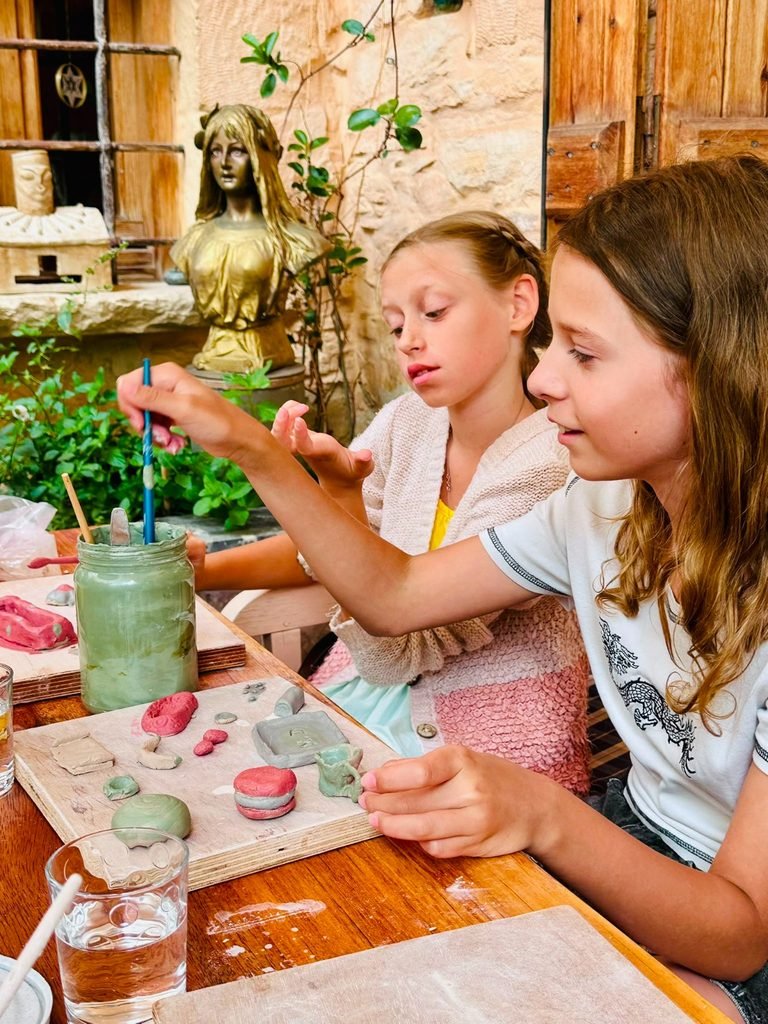
At first, clay may feel difficult, but if a person returns to it, works with it regularly and becomes familiar with it, something changes. “It’s like your hands know how to work with the material.”
For Kirsten, this is true of many handicrafts. Adults in particular have to allow themselves to begin without knowing. “You must allow yourself to say, ‘I don’t know anything about this.’ But you start and try to learn it.”
She thinks adults often struggle with the wish to be good immediately, without passing through the process of training and making mistakes. “The gift is slowly to do different kind, to make mistakes, to do it
again and be patient and be into what you are doing. Not just to be in the surface, but to go deep into what you are doing, to concentrate.” Then she added: “And be where you are now.”
Children, Creativity and Comparison
During the workshop, I had noticed that Kirsten never encouraged the children to copy her work. She showed possibilities, but the ideas remained theirs. When I asked her why, her answer was direct: “Because they shall not satisfy me. They have to play themselves. They have to find what they like to do.”
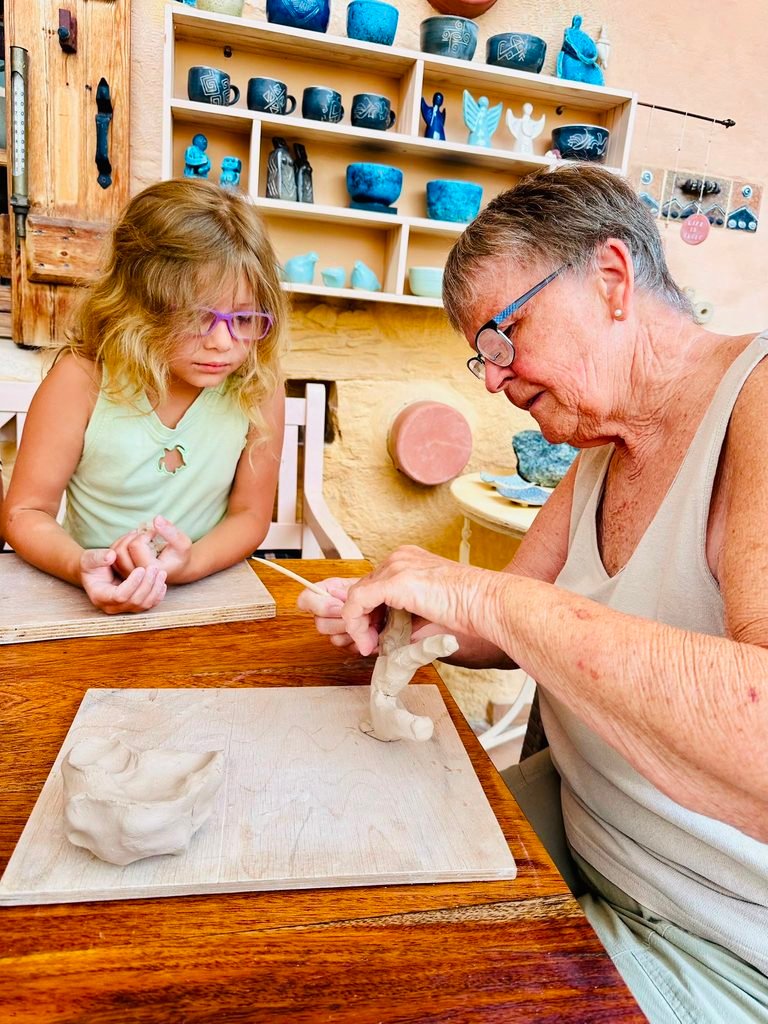
If a child needed help, Kirsten would offer it, but she believed in asking first. “Shall I help you?” If the answer was yes, she helped. If the child wanted to continue alone, she allowed that too.
Kirsten believes children need opportunities to participate in practical activities from a very young age. She spoke about children wanting to help at home, to touch things, use simple tools, help with washing up or experiment with whatever adults around them are doing.
She remembered recently seeing a video of one of her grandchildren, only a little over a year old, sitting on the kitchen counter while her mother made pizza. The child had dough in her hands and was completely occupied with it, stretching it, putting it together and changing its form.
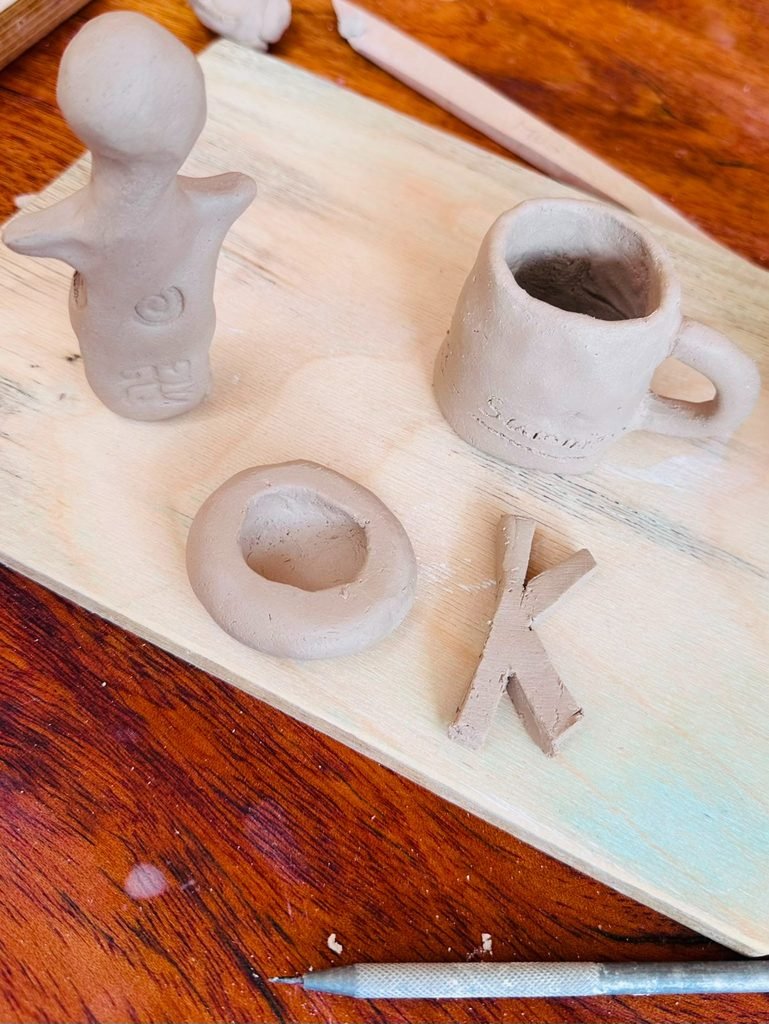
She also remembered a much more painful experience. While visiting an art school for children, she watched children who had been absorbed in their own work look around and see what others had created. Some suddenly became dissatisfied with their own pieces. Kirsten remembered children of around ten years old destroying what they had made because they thought somebody else’s work was better. “I never forget it.” She said seeing it had hurt her deeply.
During our conversation, I connected this with comparison and competition in our society. It left me wondering when the pleasure of making something becomes a judgement about whether what we have made is good enough. It also made Kirsten’s approach during our workshop clearer. The children were not making something in order to satisfy her expectations. They were finding out what they themselves wanted to do.
The Female Figurines and the Word “Care”
I eventually returned to the book Kirsten had shown me during the workshop.
I had been working from images of Neolithic female figurines, and I wanted to understand what these ancient forms meant to her personally. What was it about them that continued to inspire her?
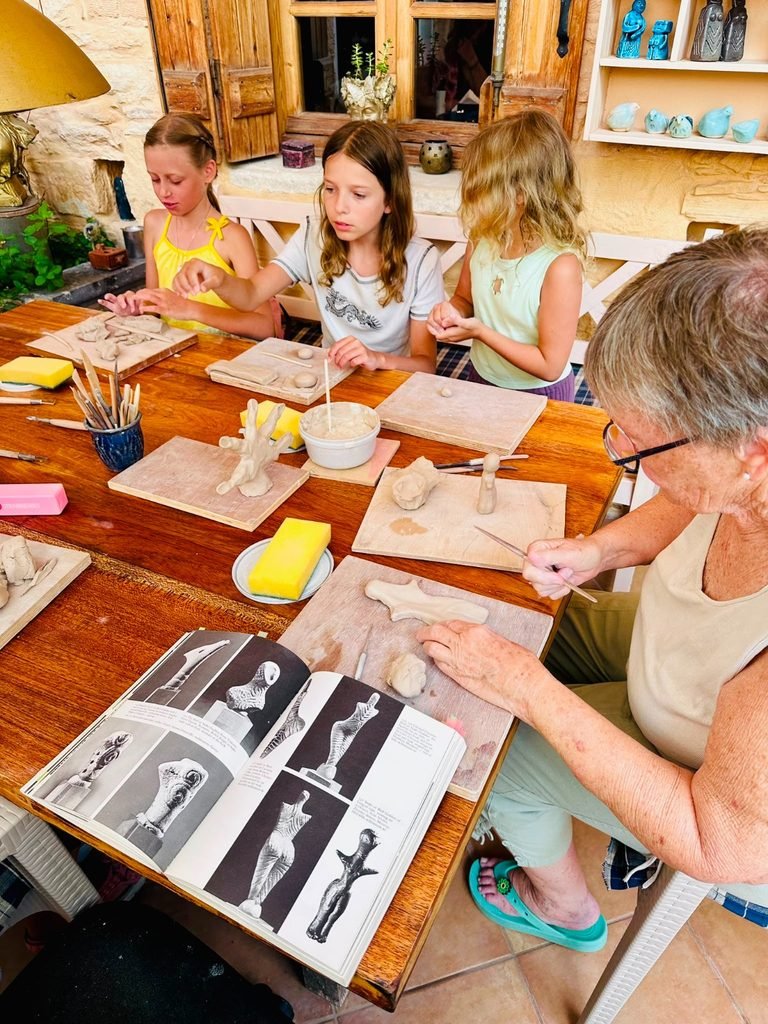
“I think the female figures show me that it’s so important that we still put the word care as a very high priority.” She continued: “That we care for each other, that we try to take care of things.”
Kirsten immediately connected this with ordinary life. She pointed to their own house and the many old things they had used there. She spoke about repairing things rather than throwing them away unnecessarily and continuing to use clothes rather than automatically replacing them. She showed me the trousers she was wearing. They were old but had been embroidered and given, in her words, “new life.” Other pieces of fabric had come from an old dress. She also spoke about buying second-hand.
Then she said: “Use what you already have. Don’t have a focus on what you don’t have. Use what you have.” For Kirsten, this can create a different feeling of richness. “It makes you much more relaxed, and it gives you a feeling of, if you have a lot of money or no, not so much money, it’s a feeling of richness that you have what you need.” I asked whether this was also about recognising that what we have can be enough. She agreed and continued by speaking about the desire always to have more.
Our conversation had begun with clay, but Kirsten’s reflections gradually led us towards something broader. When I asked what the ancient female figurines meant to her today, the word she chose was care: caring for each other, taking care of things and recognising the value of what we already have.
As she spoke, I thought of Huset i Fres, where so many objects had been rescued, repaired or brought from other places, each with its own history. I already knew some of their stories, and they were one of the reasons I had wanted my daughters to experience the house.
In Part II, our conversation turns to Kirsten and Jørgen’s home, how it took shape over time, and the personal stories behind some of the things they chose to keep.
About the Author:

Ania is a passionate community builder bringing women together across cultures and generations. She spent four transformative years in Crete – living close to nature. The island became for her a source of life-changing energy and a new path. Ania is committed to creating workshops and circles – spaces for real connection. She co-founded Women of Crete – Oi Gynaikes Tis Kritis in 2022, a vibrant community of international and Greek women. Returning to Poland in the late summer of 2025, Ania wishes to continue weaving bridges between women as she started in Crete.