
Council for the Revival of Matriarchal Arts: Nourishing Our Roots for Future Resilience
August 10, 2026
The Council for the Revival of Matriarchal Arts (CRMA) is an initiative to revive the hearth, traditional arts, and matriarchal values at the heart of our homes and communities. Our initiative is inspired by the growing field of Modern Matriarchal Studies, which provides evidence that compassion and unwavering regard for human and ecological dignity are the defining guideposts that shape the infrastructure and ethical compass of matriarchal social systems.
What, exactly, is matriarchy?
The word matriarchy and its research-backed definition are important and deeply nuanced. Perhaps because of our understanding and experience of patriarchy, uttering the word matriarchy tends to incite fierce passions, resistance, and projection. The typical knee-jerk assumption about matriarchy is that of a women-on-top scheme featuring maternal dictators and surly girl bosses; ideations that rightfully ought to raise eyebrows and critical resistance.
Increasing evidence, however, demonstrates that matriarchy is something quite different. German researcher Dr. Heide Goettner-Abendroth, through decades of inquiry, has distilled and articulated a clear and thorough definition of matriarchy. Her opus magnum, Matriarchal Societies; Studies on Indigenous Cultures Across the Globe, documents in detail what she calls “true gender egalitarian societies”. Her determination to gain clarity and access into the deep structures of peace-oriented social systems otherwise not visible or discernable to outsiders—brought her into direct contact with modern and ancient women-centered societies across Asia, Africa, and the Americas.
Goettner-Abendroth’s detailed definition of matriarchy reveals an enduring, complex, and sophisticated societal model with many features that are worthy of close consideration for meeting the seemingly intractable crises of our time. These features include social living among matrilineal and matrilocal clans, communal child-rearing, intricate gifting and sharing economies based on needs and equitable distribution, decentralized, consensus- based political systems, and self-determined, Earth-centered culture and spirituality. Thus, in matriarchy the core value is nurturing life, Mother Earth is regarded as the precious womb of life, and attuned, sensitive care for and by all members of society is the spiritual and ethical ideal.
Said another way, matriarchy is a social system structured to favor and encourage relationships and behaviors of care, responsibility, peaceable cooperation, and reciprocity.
Why Matriarchy?
Why must we use the word matriarchy—a notion that incites so much confusion and err? I, too, thought the word should be abandoned when I began learning about matriarchy at International Akademie HAGIA, as I believed it unnecessarily triggered inflammatory reactions in already-volatile public conversations. Nonetheless, I have come to understand that the word “matriarchy” carries a weight and much-needed clarity of purpose when it is well understood.
As the term menarche refers to first menstruation, matriarchy reminds us that attuned and skillful maternal care is of first, or primary, importance at the beginning of human life. Furthermore, that we each emerged from a human mother and are constructed of the water and mineral content borne of Mother Earth are facts of universal lineage. This recognition lends an opportunity to forge—or remember—a much needed sense of humane and ecological solidarity. Thus, matriarchy is a compelling word for its accuracy in designating tender, humane, and ecologically harmonious care as a crucial cultural priority.
Furthermore, informed dialogue about matriarchy within a cultural context that has lost connection with its human mothers and with Mother Earth can offer much-needed pivotal perspective. While motherhood may be theoretically held on a pedestal by the socially and economically privileged institution of the patriarchal family, mothers and behaviors inherent in mothering—sensitivity, gentleness, care, compassion, nurturance, nourishment—are systemically devalued, undermined, and shamed by the virtues and priorities of youth- obsessed, profit-driven, progress-oriented society. This value system has left astonishing numbers of women and children in severe conditions of social and economic poverty in societies otherwise considered wealthy,
advanced, and powerful. It is not coincidental then, that the same societies also behave in reckless and ignorant manner toward Mother Earth.
Recovering cultural dignity for behaviors deemed “maternal”, therefore, requires acknowledgement and restoration of what has been denigrated and cast off as subordinate slave labor. Attuned maternal care is not soft, expendable, insignificant, or shameful work; it is inherent to human survival and capacity to thrive. Thus, matriarchal systems are structured to position care, compassion, nourishment, nurturance, and cooperation among humans and Nature as central social priorities. In matriarchy, the whole of society is expected to behave like a good mother.
Matriarchal Art
The expression “Matriarchal Art” was conceived to refer to generative activities, behaviors, and skills that spiritually and practically serve life, local economies, and human self-actualization. Matriarchal Art, by our definition, includes any creative activities that wholistically heal, nurture, and care, honoring the body and spirit of the artist, the Earth, and the community. Historically, knowledge of such arts was handed down through generations, defined culture and economy, and reflected the spiritual worldview of a community. This is in dramatic contrast to modern norms of wearing corporate logos, choosing a team or political party, and accepting spiritual mandates dictated by institutions.
Seeding Matriarchal Systems in Deeply Troubled Times
The activities of CRMA, therefore, represent a “deep roots” level of restorative activism; like the attuned communications among tree roots within in the deep, dark, nutrient-rich layers of the Earth, where interdependent species collaborate to meet challenges and mount immune responses when necessary. We are remembering the life skills and spiritual arts of our ancestors—modalities through which earned wisdom was carefully curated and handed down through generations in songs, dances, arts, medicinal knowledge, and oral traditions, and cherished.
By investing time and energy to re-learn and re-invent these precious threads of wisdom for integration into our modern realities, we are laying foundations for local agency and economy through egalitarian cooperation. In this way, we also endeavor to nourish and heal the deep soil, electrical pathways, and waterways of our own bodies. Our activities, brought to life through gentle persistence, are structured to recalibrate individual physiology and communal ecosystems for co-regulation and attunement with the rhythms of the Earth herself.
At the Center of our Misson: The Hearth
The primary mission of the council is to create space and conditions where warm, supportive, and resilient bonds among women—so integral for successful flourishing of matriarchal social systems—can be remembered, re-seeded, and practiced.
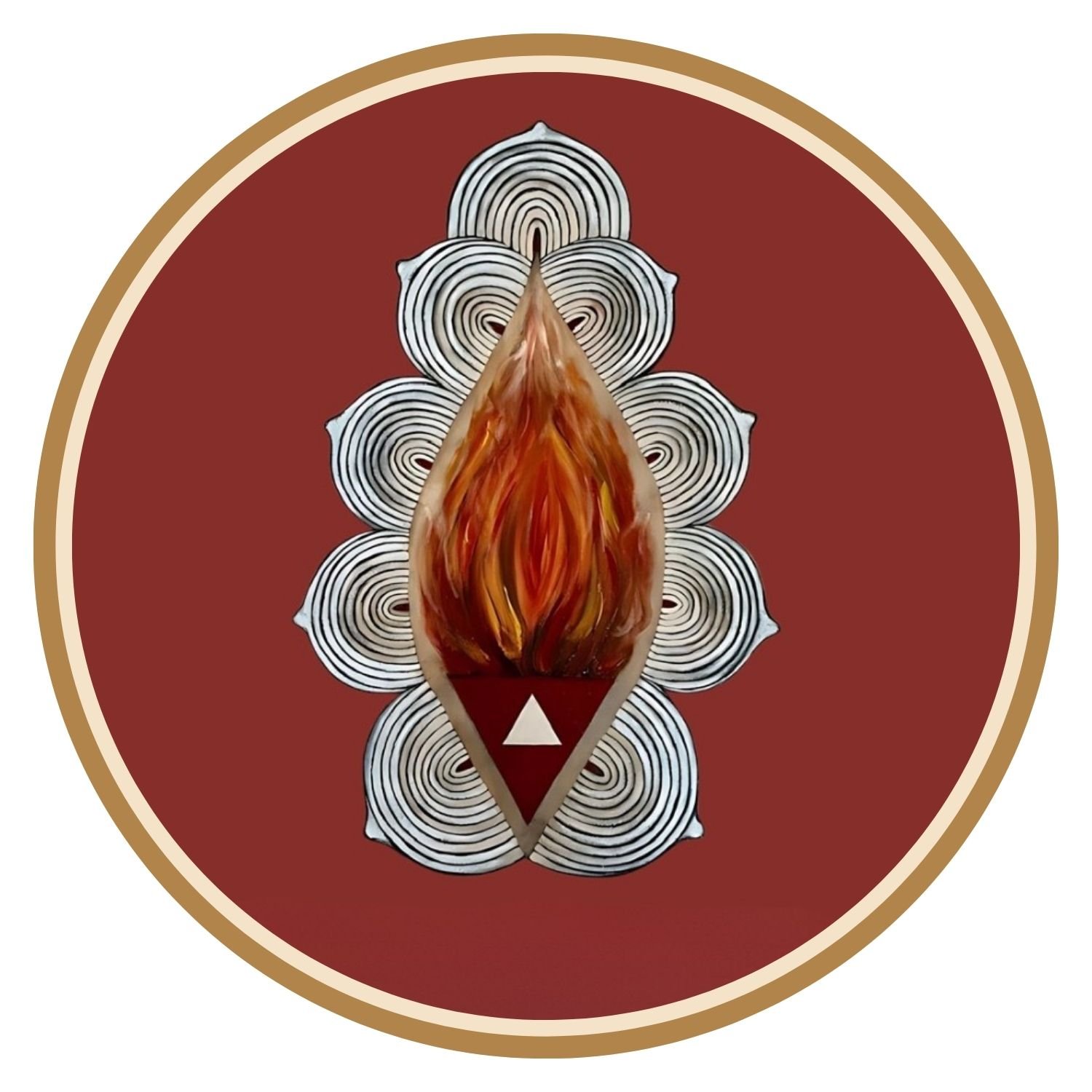
Like the word matriarchy, and like scenes scratched into ancient cave walls, painted onto clay vessels, and stitched into traditional costumes, our “logo”—the symbol we’ve crafted to represent our initiative—is rich with meaning in every detail. It reminds us with a glance why we are re-imagining the ways of the matriarchal clan to meet the challenges of our time.
The central flame represents the hearth fire we endeavor to rekindle as a central gathering space for communal activity; a space of rootedness and human belonging. A hearth represents and catalyzes a strong metabolic fire, deep nourishment, and transformative capacity.
The red downward-pointing triangle represents the pregnant, regenerative womb and life-giving blood of the Mother; the human womb as well as the womb of the Cosmos, or the Earth Mother, in which we are embedded and whose water and mineral content runs through our veins.
The white upward-pointing triangle represents the masculine aspect of creation, the counterpart of the feminine, embodied within the womb of the Mother. The smaller size of the white triangle should not be interpreted to reflect less relative importance or subservience; it is rather a depiction of the generous embrace of motherly love for all humans. Thus, the white triangle also implies the body of humanity as it exists within the great cosmic ever-generous Earth Mother. The intimate relationship between the two triangles implies material nurturing and energetic reciprocity.
The breast-like petals encircling the hearth fire suggest the principle of original nurturance. These are inspired by ancient stone carvings that have been interpreted as recorded generations and the principle of regeneration (Goettner-Abendroth, Gimbutas); each line in the multi-layered petals representing a generation of ancestry. The petals are arranged around the fire as clans gathered around a common hearth or gathering space where daily activities, festivals, celebrations, and political deliberations may be carried out. Each petal has a vulvar center point that opens toward the hearth fire, the symbolic Yoni from which the contemporary generation is birthed. Thus, nine clans are gathered around the central fire in cooperative harmony, each wrapped in the embrace and imbued with the wisdom of its ancestors.
The overall image resembles a Yoni, the entrance to the maternal sacred space where new life is nurtured into being.
Mission in Action
A Summary of the Key Aspects of the Council’s activities include:
- Reviving the hearth—the communal space where everyone belongs; where food, medicine, and practical wares are prepared and shared, and where celebrations and rituals reinforce the shared values of the community.
- The Women’s Wisdom Circle is where we study and dialogue about important, worldly issues that matter to us, including the history of matriarchal social systems. We study the works of deep thinkers and revolutionary scholars to challenge limiting beliefs, worn out social norms, and to recover perspectives on history (women’s, indigenous, peasant classes) we didn’t learn in school.
- In learning to weave and spin, we engage directly with a metaphor oft associated with “spinning fate” and weaving resilient community. We work with disparate threads that are not much or especially strong on their own and rhythmically organize them into beautiful, durable fabric.
- Ceramics is a craft in which the artisan engages directly with the elements of Earth, Air, Fire, and Water to quite magically design beautiful and durable wares that serve life. Inscriptions on pottery, in caves, and etched upon other practical wares constitute a “secret language” among women in cultures such as the Berber in Kabylia (Makilam).
- By creating practical wares with our own hands, we are developing skills and direct experience for nurturing life as well as local economy based on circulation of gifts. Development of these skills is an important first step toward cultivating direct knowledge and relationship with local resources and reducing our reliance on international trade and opaque, extractive markets. Appreciating the depth of knowledge and skill required to make beautiful wares urges us to think twice before purchasing “cheap” textiles acquired from unknown markets abroad. Such handcrafts also serve as medium for restoring lineage and sharing intergenerational wisdom and experience.
- We are re-learning the art of circle dancing as a means of communal celebration and nonverbal cooperation, expression of shared values and emotions, as well as skillful practice of leading, following, and moving in unison as an integrated whole.
By far the single most important aspect of the Council’s mission is the simple act of gathering with women regularly, around carefully conceived activities and dialogues, as a matter of habit and interdependence, and in a way that begins to repair the bonds that have been systematically severed. Conscientiously forging warm, purposeful relations with other women heals the conditioning that coerces us into relationships of competition, while gently dissolving the sense of helpless dependence on economic and social structures that force us into conflict and survival mode.
Reality Check
Lest we be accused of utopic delusion, I will be clear in asserting that we don’t have it all figured out. Our movement is not perfectly egalitarian, without tension, or independent of capitalist/patriarchal influence. We’ve created a space, however, where we can study and cultivate matriarchal wisdom and example, increase our conscious awareness of peaceful ways, and cultivate a habit of practice. The truth is this work is as tedious as it is comforting and joyful. It requires deep research and reflection, lengthy, nuanced conversations, endless trial and error, and unshakeable vision. The reality of current sociopolitical and economic conditions, our personal responsibilities, and our dependence on a troubled system make it hard sometimes to put learning new ways, studying lost histories, and sharing sacred time among sisters at the top of our priority lists.
Yet we keep circling back to one another, to our shared space, our loom, and to our small clan-like community whose roots are sprouting and showing early signs of vitality. By coming together regularly and with clear intention, we are sowing seeds of communal coherence. We witness and feel into the realities of one another in our day-to-day experiences, and this enhances our capacity for empathy, cooperation, and meaningful care. We are learning to meet problems together, to practice the art of consensus-making, and to resolve differences of opinion with grace.
In Summary
The council’s main premise is that nourishing our “deep roots” will be the game changer for our current paradigm. Our children are too often raised in situations of stress, turmoil, isolation, troubled families, and fractured communities. We are growing up less able to cope, more reactive, unable to create intimate bonds, and with a profound sense of rootlessness. So we wander out into the world looking for a place to belong; in search of the most basic sense of security. We fall into traps of addiction, ideology, the need to pick a team, and to prove we’re “great” as a life purpose, to somehow convince ourselves and others that we have value and meaning. This is the social pathology that keeps us at war, and it has to stop.
Psychologist Shelly Taylor concluded in her book The Tending Instinct that “Social ties are the cheapest medicine we have. When we erode our social and emotional ties, we pay for it long into the future. When we invest in them instead, we reap the benefits for generations to come.” The mission of CRMA is to start small, but to go deep. In our view, the tender and finely tuned model of the maternal clan warrants serious consideration as a sophisticated deep-roots level solution.
Bibliography and Resources
Garfinkel, Y. (2003). Dancing at the Dawn Of Agriculture. Austin: University of Texas Press.
Gimbutas, M. (1989). The Language of the Goddess. Thames & Hudson.
Goettner-Abendroth, H. (2013). Matriarchal Societies: Studies on Indigenous Cultures Across the Globe. New
York: Peter Lang
Makilam. (2007). The Magical Life of Berber Women in Kabylia. Peter Lang. (pg 5)
Tarsha, M., & Narvaez, D. (2019). The Evolved Nest: A partnership system that fosters child wellbeing.
International Journal of Partnership Studies, 6(3). Open access: doi.org/10.24926/ijps.v6i3.2244
Shannon, L. (2017). Women with Wings: Right-brain Consciousness and the Learning Process in Balkan Dance,
in Voss, A. and Wilson, S. (ed) Re-Enchanting the Academy. Rubedo Press. (pp 325-348).
Taylor, S. (2002). The Tending Instinct: How Nurturing is Essential to Who We Are and How We Live. New
York: Times Books, Henry Holt and Company.
https://matriarchalartscouncil.com/the-realm-of-matriarchal-arts-the-heart-and-earth-of-resilient-communities/
https://matriarchalartscouncil.com/wisdom-circle-agreements-learning-growing-in-community-self-determination/
International Academy HAGIA
Maternal Gift Economy Movement
The Evolved Nest
About the Author:

Jennifer Eva Sirel-Pillau, mother of two, is a founding member of the Council for the Revival of Matriarchal Arts (CRMA). Jennifer holds a bachelor’s degree in business administration, a master’s degree in Traditional Chinese Medicine, as well as certifications in Ayurvedic Practice and Craniosacral Therapy. Her interest turned to matriarchy when it became clear in her role as a healer that virtually all chronic illnesses—physical, emotional, spiritual, and relational—share root causes that can be traced to the degradation of our social and ecological fabric. She studied matriarchal societies and matriarchal theory at International Academy HAGIA, based in Germany, with the institute’s founder, Dr. Heide Goettner-Abendroth. During this experience, she wrote a two-part thesis entitled “In the Beginning: The Real Meaning of Matriarchy,” and “Men in Matriarchy: Toward a World of Relational Integrity.” Her pen name is the name of her mother’s Estonian lineage.